Meta Fundamental AI Research
Robotics.
First & only designer on a team of scientists — I defined design's role in human–robot interaction from scratch, then invented the method to prove it.
First & only designer on a team of scientists — I defined design's role in human–robot interaction from scratch, then invented the method to prove it.
My first assignment: showing what a robot dog was about to do, rendered in VR above its head. It shipped publicly — and did two things that shaped everything after. It proved VR could make a machine legible (the foundation for my method), and surfaced a question I couldn't shake: people badly want to know what a robot will do next.
Once the demo shipped, the team went back to the models and the hardware — and there was nothing defined for a designer to do next. Neither my manager nor I knew what design was even for here. A genuinely lost stretch.
Instead of waiting for a brief, I sat down and asked myself two questions:
The team — like most of the field — was racing on the technology: better movement, better dexterity. How people would actually communicate with and trust a robot at home was a blank — and it matters just as much. Studied early, it surfaces real problems in time to steer model training. So I turned that into a research agenda — six dimensions of the human–robot relationship the team could see, fund, and build around.
There was no robot mature enough to test, and surveys only collect opinions. So I invented one: a 1:1 immersive VR study with a Wizard-of-Oz robot. Because the user never knew a person was behind it, the operator could improvise any behavior we wanted to test that day — with no code and no hardware.
The user meets a life-size robot in VR. In an identical room next door, a hidden operator stands in the very same spot — the whole study runs as one mirrored space.
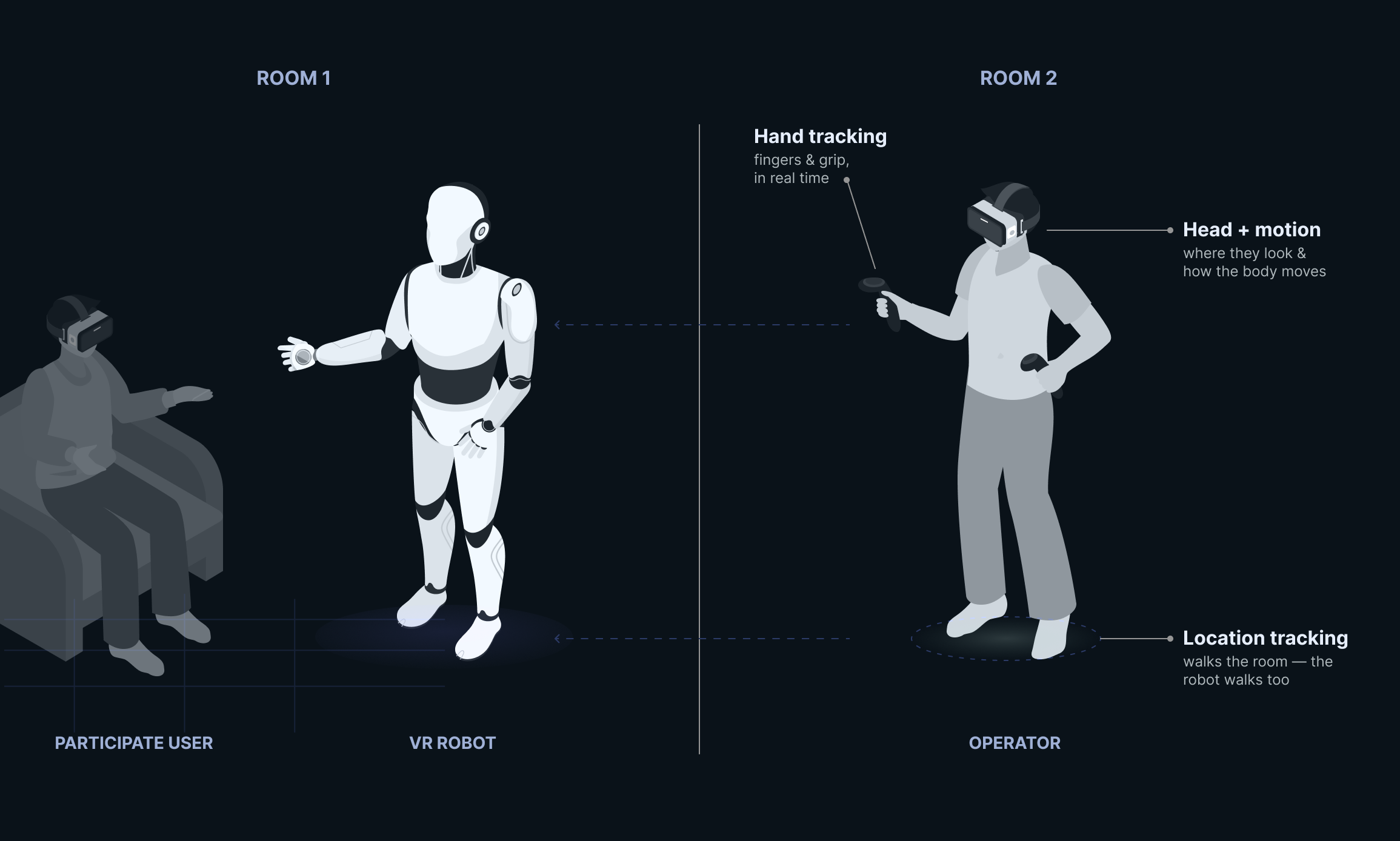
The headset tracks the operator's hands, head & motion, and location. Each signal drives the robot in real time — it reaches, gestures and walks exactly as the operator does.
It made the six dimensions testable, not theoretical — and demo-able enough to spread. The honest caveat: a human-driven robot moves more smoothly than a real one, so I read results as relative preferences, not absolute performance.
The clearest sign design's new role mattered: the team was betting on cooking as a flagship use case — until my study.
People also cared not just whether the robot could pick up a cup, but how it reached for one — which spun off a second study to steer training away from motions users disliked.
I made the study demo-able — one operator, one user, instantly legible — then took it on the road. Interest snowballed: other orgs hit the same "no hardware, need real feedback" wall, wanted in, and kept asking to collaborate.
The robots aren't here yet — but how we'll live with them is the part worth figuring out first.